 Citenook1
Blog · Privacy
Private AI: what it really means, and the most private ways to use it
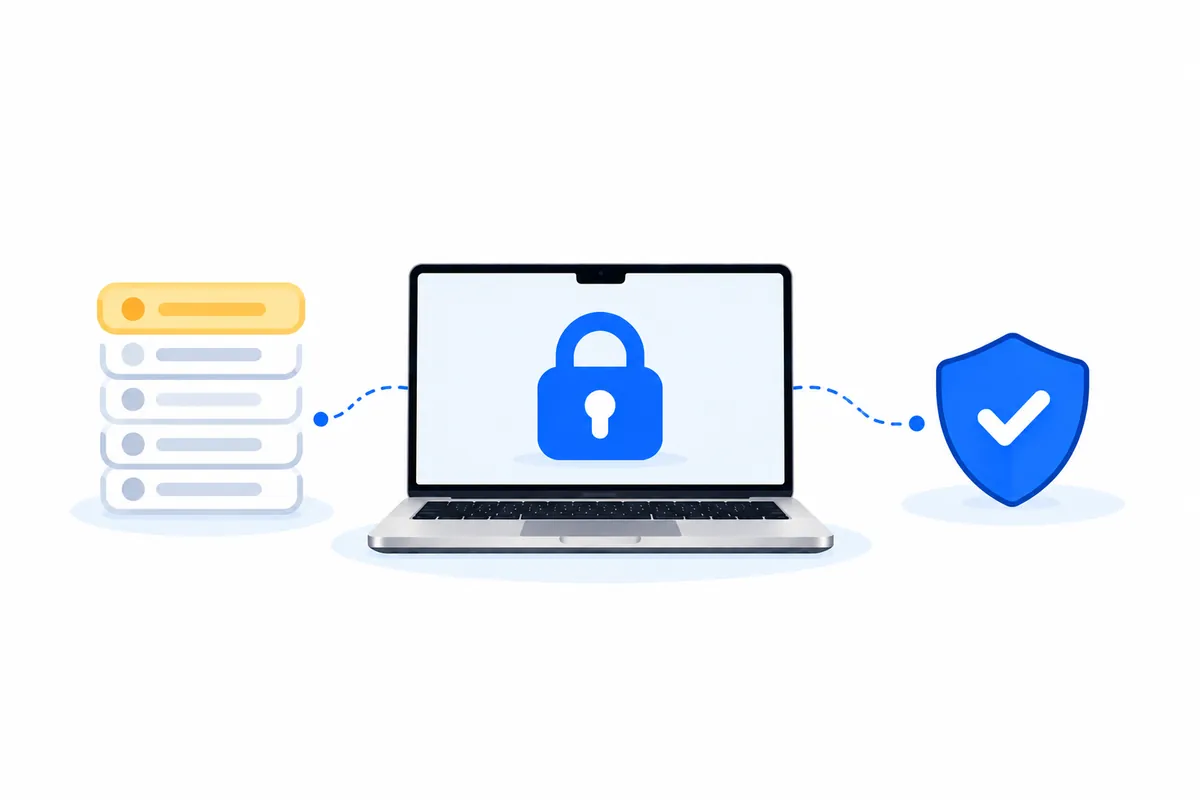
Private AI means an AI tool that doesn't keep, read or train on what you type. Only AI that runs on your own device is fully private, because nothing leaves it. Next come services built so they can't see your chats, then privacy-focused chat services like Proton Lumo, Duck.ai, Venice and Brave Leo that promise not to store or train on them, and last, mainstream chatbots with their training settings turned off.
This guide explains the five levels of private AI, seven questions to check any privacy claim, the main options at each level, and which to pick. Facts come from each company's own privacy pages, checked on 23 October 2026. Businesses also use "private AI" for models run on their own servers; this guide is about the AI tools people use day to day.
The five levels of private AI
"Private" gets used for very different things. This is our way of sorting them, from most to least private:
| Level | What it means | Examples |
|---|---|---|
| 1. On your device | The model runs on your computer or phone; nothing is sent | LM Studio, Ollama, Jan, Apple's on-device models |
| 2. Sealed cloud | Runs on servers built so even the company can't see your prompts, and that you can check | Apple Private Cloud Compute, Confer |
| 3. Privacy-focused services | The company promises not to store, log or train on chats | Proton Lumo, Duck.ai, Venice, Brave Leo |
| 4. Mainstream, settings off | Normal chatbots with training turned off | ChatGPT, Claude, Gemini |
| 5. Business plans | No training by default, with contracts and admin controls | ChatGPT Business, Claude Team, Gemini in Workspace |
Levels 1 and 2 rely on how the system is built. Levels 3 to 5 rely on a company keeping its promises.
Seven questions to check any "private AI" claim
- Does it train on your chats? Look for a clear "no," not "we may improve our services."
- How long is it kept, and where? On your device, on their servers, or deleted right away?
- Are prompts logged? Even short-term logs can be read or handed over.
- Who can read it? Staff, outside reviewers, the AI provider behind the app, or nobody?
- Is it encrypted so they can't read it? Encryption in transit is standard; what matters is whether the company can read your chats while they're processed and stored.
- Is the code open, and can you check what runs? Open source and published builds let outsiders verify.
- Is there another AI company behind it? Many private apps pass your prompt to OpenAI, Anthropic or others, under that company's terms.
Level 1: AI on your own device
The only option where your words never leave your hands. Apps like LM Studio, Ollama and Jan download a model once and run it offline; on a phone, apps like PocketPal AI do the same. The trade-off is smaller, less capable models and needing enough memory. Our guides to offline AI and LM Studio on a Mac cover the apps and which models fit your computer.
Level 2: sealed cloud
- Apple Private Cloud Compute. When Apple Intelligence needs a bigger model, it sends the request to Apple servers that, Apple says, keep "no user data" after the response, with software images published so researchers can check them.
- Confer. Announced in January 2026 by Moxie Marlinspike, who created Signal, it encrypts chat history with keys that "never leave your devices" and runs the model in a Trusted Execution Environment, hardware the server's owner can't look inside. Its builds are "bit-for-bit reproducible," so anyone can check what's running. Pricing and models weren't listed on the pages we read.
Level 3: privacy-focused chat services
| Service | What it says | The catch |
|---|---|---|
| Proton Lumo | "No logs of what you ask, or what Lumo replies"; saved history uses zero-access encryption; no training; open-source code; runs on servers Proton controls | The model still has to read your prompt to answer. Plus is $9.99 a month billed yearly |
| Duck.ai | "Does not record or store any of your chats"; removes your IP address; providers must delete prompts right after replying and never train on them | Some providers may keep chats "where required by law or as necessary to combat malicious use" |
| Venice | History "stays on your device. Venice never stores it on its servers"; prompts are relayed without being stored | In its mode that uses frontier models, Venice says "you should assume the provider is storing your content" |
| Brave Leo | "Doesn't retain or share chats, or use them for additional model training"; no account needed; can use your own local model | Built into the Brave browser |
These are good choices for everyday questions you'd rather keep to yourself. They rely on policies and contracts, so read the exceptions.
Levels 4 and 5: mainstream chatbots and business plans
ChatGPT, Claude and Gemini can be made more private, but their defaults aren't: ChatGPT and Gemini train on personal chats unless you switch it off, and Gemini keeps them 18 months by default. Business plans don't train on your data by default. Our guides cover each one: is ChatGPT confidential, is Claude safe, is Gemini safe and is Copilot safe.
Which private AI should you use?
- Confidential files, client work, health or legal documents: level 1, on your device.
- Sensitive questions where you want strong guarantees: level 2, sealed cloud.
- Everyday chat you'd rather not have stored: level 3, a privacy-focused service.
- You need the best models for work: level 5, a business plan, with names left out.
Private AI for your own files
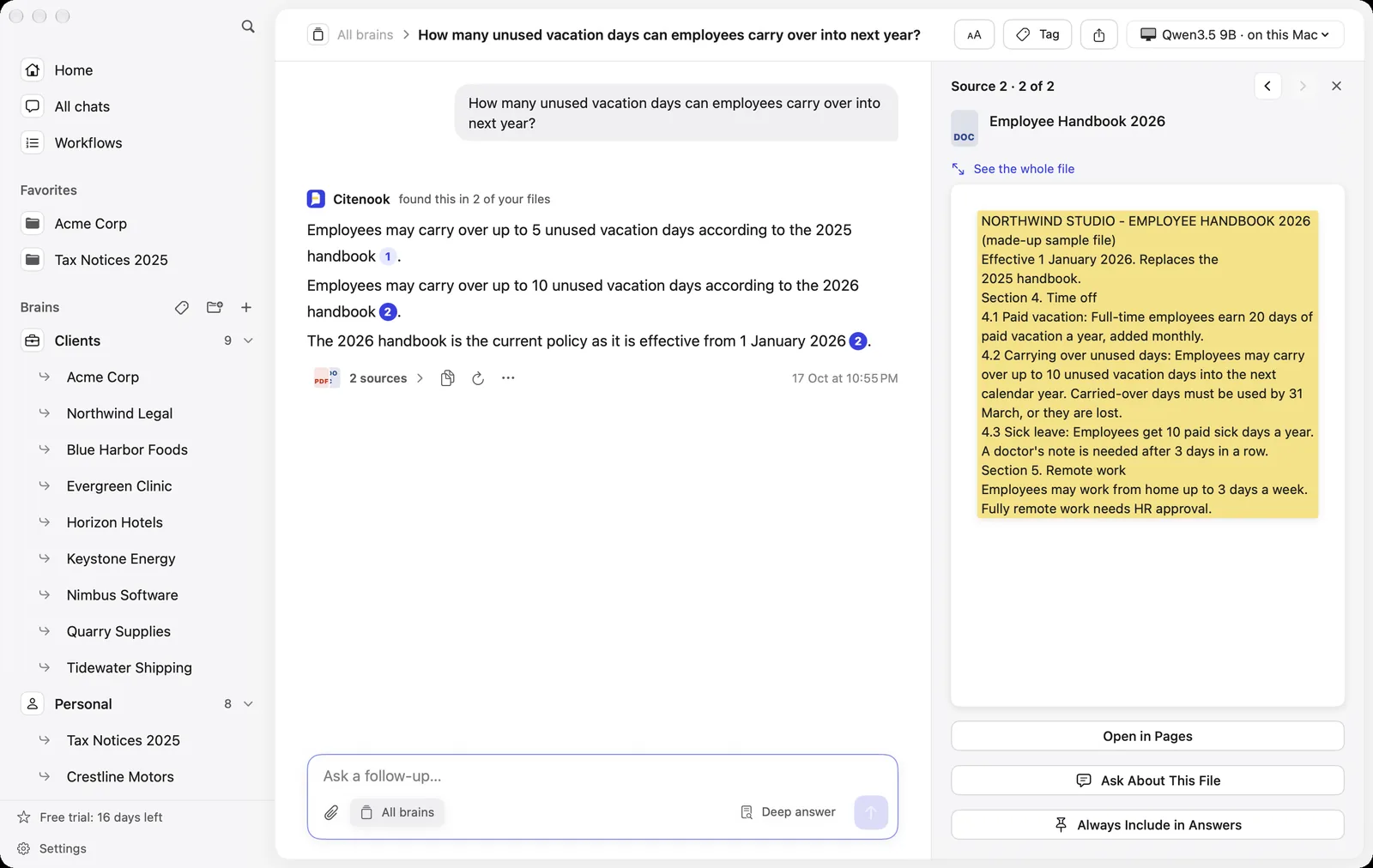
Most private AI apps are for chatting. If your questions are about your own documents, Citenook is a Mac app built for that, at level 1: it reads your folders of PDFs, Word files and notes on your Mac, answers with Apple Intelligence or a model you download, and links every answer to the exact passage. Nothing is uploaded. If you choose an online AI with your own key instead, only the passages for that answer are sent, with names and numbers hidden first, and you can preview what goes. See how it fits lawyers, accountants and doctors, or read Citenook vs Elephas.
It also answers everyday questions from what the model knows. It has no web search, it's Mac only, and it starts at $9.99 a month after a 30-day free trial.
Questions
What is private AI?
AI that doesn't keep, read or train on what you type. The strongest kind runs on your own device. Others rely on sealed servers or on a company's promise not to store your chats.
What is the most private AI chatbot?
One that runs on your own device, like LM Studio, Ollama or Jan, because nothing is sent. Online, sealed services like Confer and Apple's Private Cloud Compute go furthest; Proton Lumo, Duck.ai, Venice and Brave Leo promise not to store or train on chats.
Is Venice AI really private?
Venice says your history stays on your device and prompts are relayed without being stored. In its mode that uses outside frontier models, it says to assume the provider is storing your content. See our guide to Venice AI alternatives.
Is Duck.ai private?
DuckDuckGo says it doesn't store your chats, removes your IP address, and has model providers delete prompts right after replying, with exceptions for legal reasons or misuse.
Can AI be truly private?
Yes, if it runs entirely on your own device. Anything that sends your words to a server depends on how that server is built and on the company's promises.
Is ChatGPT private?
Not by default. Personal plans can train on your chats unless you turn it off, and chats are kept until you delete them. Business plans don't train on your data by default.
Sources, checked 23 October 2026: Venice privacy and pricing; Proton Lumo privacy and Lumo; DuckDuckGo Duck.ai privacy; Brave Leo; Apple Private Cloud Compute; Confer private inference. ChatGPT, Claude and Gemini facts from our earlier guides. Screenshot from our own test with made-up files.