 Citenook1
Blog · Guides
ChatGPT for lawyers: what it's good for, and where it gets you sanctioned
Lawyers can use ChatGPT for drafting, plain-language explanations and summaries of public material, as long as they check everything it writes. The two real risks are invented case law and client confidentiality. A public tracker had logged 2,190 court decisions involving AI hallucinations by 15 October 2026, and the ABA says lawyers need a client's informed consent before putting their information into a tool that may learn from it.
This guide covers what ChatGPT is good and bad at in a law practice, the sanctions so far, what ABA Formal Opinion 512 asks of you, OpenAI's new legal product, which plan to use, a checklist and prompts that need no client data. Facts come from court records, the ABA, state bars and OpenAI's own pages, checked on 16 October 2026. It's a summary, not legal advice.
What ChatGPT is good at in a law practice
- First drafts of routine writing. Client update emails, engagement letter cover notes, internal memos on procedure, blog posts and newsletters. Describe the situation without names and edit the result.
- Plain-language explanations. Turning a statute or a clause you've already read into words a client understands.
- Summaries of public material. A published opinion, a new rule or a long regulation, as a starting point before you read the original.
- Lists and outlines. Deposition question ideas, issue checklists, the structure of an argument, a timeline template.
- Tone and clarity. Making a letter firmer, shorter or friendlier, and catching grammar mistakes.
The ABA agrees this kind of use is low risk: when no client information goes in, such as using a tool for ideas, the client's consent "would not be necessary."
Where it goes wrong: fake cases and sanctions
ChatGPT predicts plausible text. Ask it for case law and it can produce citations, quotes and holdings that don't exist, written with full confidence. The ABA describes these as "ostensibly plausible responses that have no basis in fact or reality." Courts have been firm about it:
| Case | Court and date | Sanction |
|---|---|---|
| Mata v. Avianca | S.D.N.Y., June 2023 | $5,000 against two lawyers and their firm |
| Noland v. Land of the Free | California Court of Appeal, September 2025 | $10,000 and a referral to the State Bar (reported) |
| Couvrette v. Wisnovsky | D. Oregon, December 2025 | About $110,000 in fines and fees against two lawyers, case dismissed (reported) |
| Whiting v. City of Athens | 6th Circuit, March 2026 | $15,000 per lawyer plus the other side's fees (reported) |
Damien Charlotin's public database listed 2,190 court decisions dealing with AI hallucinations worldwide on 15 October 2026, from lawyers and people representing themselves. In Mata, the judge also wrote there is "nothing inherently improper" about using a reliable AI tool. The problem is filing what it says without checking.
Two more weak spots: ChatGPT's legal research misses recent and local law, and it knows nothing about your client's facts unless you paste them, which is the next problem.
What ABA Formal Opinion 512 asks of you
The ABA's first ethics opinion on generative AI (29 July 2024) applies existing Model Rules. In plain words:
- Competence (Rule 1.1). You "need not become GAI experts," but you need a reasonable understanding of what the tool can and can't do. Relying on it without independent checking can violate this rule.
- Confidentiality (Rule 1.6). Before putting client information into a self-learning tool, you need the client's informed consent, and general boilerplate in an engagement letter "is not sufficient." Read the tool's terms of use and privacy policy.
- Communication (Rule 1.4). Sometimes you must tell clients you use AI, depending on the task, their expectations and how sensitive the information is.
- Candor and supervision (Rules 3.3, 5.1, 5.3). Review output before anything goes to a court. Managing lawyers must set clear firm policies on AI and train staff.
- Fees (Rule 1.5). Hourly lawyers "must bill for their actual time," and can't charge clients for learning a tool they use regularly.
State bars say similar things. Texas Opinion 705 (February 2025) says to "always verify the accuracy" of AI answers. NYC Bar Opinion 2024-5 warns that open systems share what you type with third parties. Florida Opinion 24-1 recommends informed consent before confidential information goes into third-party AI. California proposed AI comments to its rules in March 2026; they hadn't been adopted when we checked. Check your own state's rules, and any standing orders from your judges.
OpenAI's legal version: Astra for Law
On 17 September 2026, OpenAI announced Astra for Law: its GPT-6 Astra model with a legal search index of US case law, statutes and regulations, plus controls for client matters. It's offered first to selected law firms through an invite program, not to ordinary ChatGPT Plus users. OpenAI also made ChatGPT for Word generally available, with plugins for tools like Clio, iManage and Thomson Reuters.
On OpenAI's own legal research test, Astra for Law answered 54.0% of questions fully correctly, against 38.7% for the general model with web search. That's real progress, and it still means checking every answer. Dedicated legal tools such as Harvey, CoCounsel from Thomson Reuters and Lexis+ with Protégé connect AI to verified legal databases; none of them publish prices.
Which ChatGPT plan a lawyer should use
| Free, Go, Plus, Pro | Business | Enterprise | |
|---|---|---|---|
| Trains on your chats | Yes, unless you turn off "Improve the model for everyone" | Not by default | Not by default |
| Zero data retention or custom terms | No | No, needs a sales contract | Through sales |
| Price | Plus $20 a month; Pro $100, $200 or $500 a month | $25 per user a month ($20 billed yearly), 2 users or more; Premium seat $125 | Not public |
A personal Plus account with training on is the "self-learning tool" Opinion 512 worries about. Business is the minimum for anything near client work, and even then your files sit on OpenAI's servers, so the consent and confidentiality analysis still applies. Our guide to pasting client files into ChatGPT compares retention and human review across ChatGPT, Claude and Gemini.
A checklist for firms
- Write an AI policy: which tools, which plans, what may never be pasted, who checks the output.
- Use a business plan with training off by default, never personal accounts.
- Leave client identity out: names, case numbers, addresses, account numbers, anything that points to the matter.
- Get informed consent before client information goes into any AI tool, specific to the use.
- Read every case you cite in a real database, and run it through a citator.
- Check your judge's standing orders for AI disclosure or certification rules.
- Bill actual time, and be open with clients about AI where it matters.
Prompts that need no client data
- "Draft a short email telling a client their hearing has moved by two weeks and what happens next. Warm, under 120 words."
- "Explain the difference between a deposition and an interrogatory to someone with no legal background, in five sentences."
- "Give me a checklist of documents to request in a commercial lease dispute."
- "Rewrite this paragraph so it's clearer and half as long: [your text, no names]."
- "Outline a firm newsletter article on what small businesses should check before signing a vendor contract."
- "List questions to ask a new client at intake for a slip-and-fall claim."
When the answer is in your own files
Many questions in a matter aren't legal research at all: what did the witness say, when was the incident reported, which version of the contract changed the notice period. The answer is in your files, and those are exactly the files you shouldn't paste into ChatGPT.
Citenook is a Mac app that answers questions from folders of transcripts, letters, notes and contracts without uploading them. With Apple Intelligence or a model you download, nothing leaves your Mac. Every answer links to the passage it came from. We tried it on four made-up files from a slip-and-fall matter: client intake notes, a deposition excerpt, an incident report and a client email.
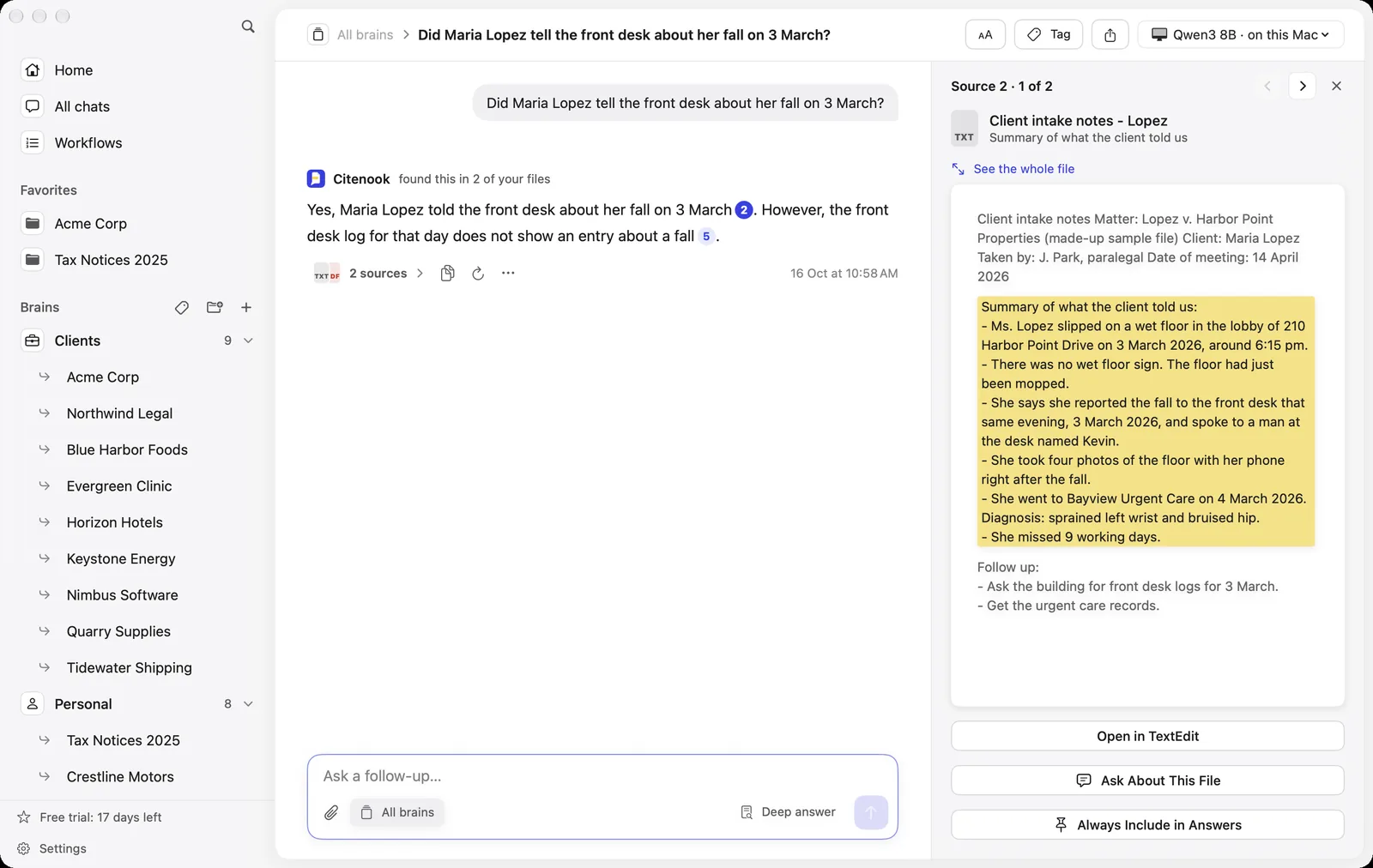
It found the conflict between the client's account and the property manager's testimony in about a minute. It also shows why you read the source: the answer said "Yes, Maria Lopez told the front desk," while the intake notes only say she says she did. The highlighted passage makes that easy to spot. A broader first question ("When did she report the fall, and do the files agree?") missed the intake notes, so specific questions work better.
Be clear about its limits: Citenook doesn't research case law, check citations against a citator, draft briefs or redline. It isn't certified for SOC 2 or similar standards. It's Mac only, free for 30 days, then from $9.99 a month. For contracts, see our guide to AI contract review, and Citenook for lawyers shows how it fits a practice.
Questions
Can lawyers use ChatGPT?
Yes. The ABA's Opinion 512 allows it under existing rules: understand the tool, check its output, protect client information, tell clients when it matters and bill fairly.
Is it ethical to put client information into ChatGPT?
Under Opinion 512, a self-learning tool needs the client's informed consent first, and engagement letter boilerplate isn't enough. A business plan that doesn't train on your data lowers the risk but doesn't remove your confidentiality duty.
Can ChatGPT do legal research?
Only as a starting point. It can invent cases and quotes, and courts have sanctioned lawyers for filing them. Verify every citation in a legal database. Even OpenAI's new Astra for Law got 54% of research questions fully right on OpenAI's own test.
What happened to the lawyers who used fake ChatGPT cases?
In Mata v. Avianca (2023) the court fined two lawyers and their firm $5,000. Later sanctions grew: reported penalties include $15,000 per lawyer in the 6th Circuit in 2026 and about $110,000 in an Oregon federal case.
Which ChatGPT plan is best for a law firm?
Business at minimum ($25 per user a month, $20 billed yearly), because OpenAI doesn't train on it by default. Larger firms needing zero data retention or custom terms talk to OpenAI's sales team about Enterprise.
Is there a way to use AI on case files without uploading them?
Yes. Run the model on your own computer, so the files are never sent anywhere. On a Mac, apps like Citenook do this and show the exact passage behind each answer.
Sources, checked 16 October 2026: ABA Formal Opinion 512; Mata v. Avianca opinion and order; ABA Journal on Couvrette v. Wisnovsky; Damien Charlotin's AI Hallucination Cases database; Texas Opinion 705; NYC Bar Formal Opinion 2024-5; State Bar of California proposed AI rule comments; OpenAI Astra for Law, data controls, Plus, Pro and Business. Noland and Whiting sanctions as reported by McGuireWoods and LawSites. Citenook screenshot from our own test with made-up sample files.