 Citenook1
Blog · Privacy
Is Claude HIPAA compliant? Only some plans, and only with a signed agreement
Claude isn't HIPAA compliant by default. Anthropic will sign a business associate agreement (BAA) only for HIPAA-ready Enterprise plans and its API, so Free, Pro, Max, Ultra and Team can't be used with patient data. Even on a covered plan, features like connectors stay outside the agreement, and signing doesn't make your practice compliant by itself.
This guide covers which Claude plans qualify, what the agreement leaves out, what it costs a small practice, whether removing names is enough, and your other options. We also ran a made-up patient letter through our own app's hiding step, and show what it missed. Facts come from Anthropic's and the US health department's own pages, checked on 3 November 2026. Citenook isn't connected to Anthropic, and this isn't legal advice, so check your setup with your compliance lead.
Which Claude plans can be HIPAA compliant?
Only some. Here's each way of using Claude, and whether Anthropic's BAA can cover it.
| How you use Claude | Anthropic BAA? | What it takes |
|---|---|---|
| Free, Pro, Max, Ultra | No | Can't be turned on |
| Team | No | Can't be turned on |
| Enterprise | Yes, once enabled | The Primary Owner accepts the BAA and enables HIPAA. A standard Enterprise plan has no coverage until then |
| Claude API | Yes, once enabled | A signed BAA and a HIPAA-ready organization, and only for covered API features |
| Claude in Microsoft Foundry | Yes, with setup | A BAA plus the HIPAA configuration, requested through Anthropic |
| Amazon Bedrock | No, AWS's instead | AWS lists Bedrock as HIPAA eligible, so you'd need a BAA with AWS |
| Google Vertex | No | Anthropic says services bought through clouds such as Vertex aren't covered by its BAA. Check Google's terms |
Anthropic is direct about it: "Team plans and individual plans (Free, Pro, Max, and Ultra) can't enable HIPAA." Team is the one that catches people out, because it's a business plan that doesn't train on your data by default. That helps with privacy, but it isn't a BAA.
Why the agreement matters
HIPAA applies to health plans, clearinghouses and most healthcare providers, called covered entities, and to the companies that handle patient data for them. The US health department (HHS) says an online service that processes or stores patient data on your behalf is a business associate, even if it only holds encrypted data and has no key.
So you need a BAA first. HHS says that if you use a cloud service for patient data without one, you are "in violation of the HIPAA Rules." It has settled a case with a provider that stored data on over 3,000 people on a cloud server without a BAA.
Two more points from HHS and Anthropic are worth knowing:
- No product is "HIPAA certified" by the government. HHS says its Office for Civil Rights "does not endorse, certify, or recommend specific technology or products."
- A BAA is only one part. You still have to do your own risk analysis, control who has access, and use only the covered features. Anthropic calls the setup HIPAA-ready, which is a fair way to put it.
What Anthropic's BAA covers, and what it leaves out
Patient data should go only through covered features. Here's the short version for the Enterprise plan and the API. Anthropic's Implementation Guide on its Trust Center is the full list, and your signed BAA is what counts.
| Covered | Not covered | |
|---|---|---|
| Enterprise | Chat, Projects and Artifacts in chat, file creation and code execution with no network access, voice, web search, research | Connectors, Enterprise Search, Claude in Chrome, skills, Claude in Office beta features. Cowork in the cloud and Dispatch aren't available |
| API | Messages API features such as prompt caching, memory, web search and computer use | Batch, Files, Skills, Code Execution, Web Fetch, external MCP, and the Claude Console |
| Claude Code, Cowork on your computer | Only with the extra HIPAA configuration applied. Claude Code with a Console key needs zero data retention instead | VS Code and JetBrains extensions, cloud sessions, connectors |
The biggest trap is connectors. Linking Claude to your Gmail, Drive or EHR can look like normal use of a covered plan, but Anthropic lists connectors as available and not covered. See our guide to what Claude connectors can read.
How to turn on HIPAA in Claude
- Get an Enterprise plan. Only the organization's Primary Owner can do the next steps.
- Go to Organization settings, Data and privacy, HIPAA Compliance, and choose Enable.
- Download and read the BAA and the Implementation Guide.
- Click to accept. The self-serve BAA is a standard agreement and can't be changed.
- Turn off or avoid the features that aren't covered, and tell your staff which ones those are.
Read first, because Anthropic says this can't be undone from settings, and it resets some organization settings to their defaults.
What it costs a small practice
Enterprise costs $20 per seat a month, billed yearly, with a 20-seat minimum, and usage is billed on top at API rates. So the entry price is $4,800 a year before anyone asks a question. That's hard to justify for a practice of three people. The API has no seat minimum, but it's for building your own tool, so you'd need a developer.
Can you just remove the patient's name?
Not by itself. HHS says a cloud service isn't a business associate if it only receives properly de-identified data, but its Safe Harbor method means removing 18 kinds of identifiers. Those include all dates tied to the patient except the year, anything more local than a state, record numbers, device serials and web addresses. A name is only one of them.
To see how easy this is to get wrong, we tested our own app. Citenook has a setting that hides personal details before text goes to an online AI. We ran its hiding code, from version 1.0.7, on a made-up referral letter. All names and numbers here are invented.
| Hidden | Still visible |
|---|---|
| Patient's name, doctor's name | Date of birth |
| Phone number | Visit and admission dates |
| Email address | Medical record number |
| Social Security number | Health plan ID |
| City | Street number and ZIP code |
| Device serial number, patient portal link |
So Citenook's hiding doesn't meet Safe Harbor, and it shouldn't be treated as de-identification. It was built to reduce what reaches an AI service, not to meet this standard. Copying a note into Claude with the name deleted would leave even more behind.
Your options if you're a small practice
- Keep patient data out of Claude. Personal Claude is still useful for drafting policies, patient handouts and learning, with no patient details in the prompt.
- Use a healthcare tool with its own BAA. Several vendors sell these, some built on models like Claude. Get the BAA in writing and read what it covers.
- Use Enterprise or a cloud provider if you have the size, or an IT partner, to run it properly.
- Fully de-identify the text first, using one of HHS's two methods, if you have someone who can do it reliably.
- Run the AI on your own computer, so patient files don't go to an AI company at all.
When patient files shouldn't leave your computer
Citenook is a Mac app that answers questions from your files with a model running on the Mac. With that setup, the files, questions and answers stay on the Mac, it works with Wi-Fi off, and we never receive any of it. Each answer links to the passage it came from, which helps when you need to check a letter or report. See how it fits doctors.
Be clear about the limits. Citenook isn't certified for HIPAA, and keeping data on a Mac doesn't remove your other duties, like encrypting the disk and controlling who can use the computer. Don't connect an online AI for patient files, since its service would then receive them, and our hiding step isn't de-identification, as the test above shows. It's for one person on a Mac, doesn't connect to an EHR, and gives no medical advice. It's free for 30 days, then from $9.99 a month. Whether it fits your obligations is for your practice to decide. See what goes where.
Questions
Is Claude Pro HIPAA compliant?
No. Anthropic says Free, Pro, Max and Ultra can't enable HIPAA, so don't put patient data in them, even with training turned off.
Will Anthropic sign a BAA?
Yes, for HIPAA-ready Enterprise plans, the first-party API and Claude in Microsoft Foundry. It doesn't sign one for individual or Team plans. A BAA covers only the organization that accepted it.
Is the Claude Team plan HIPAA compliant?
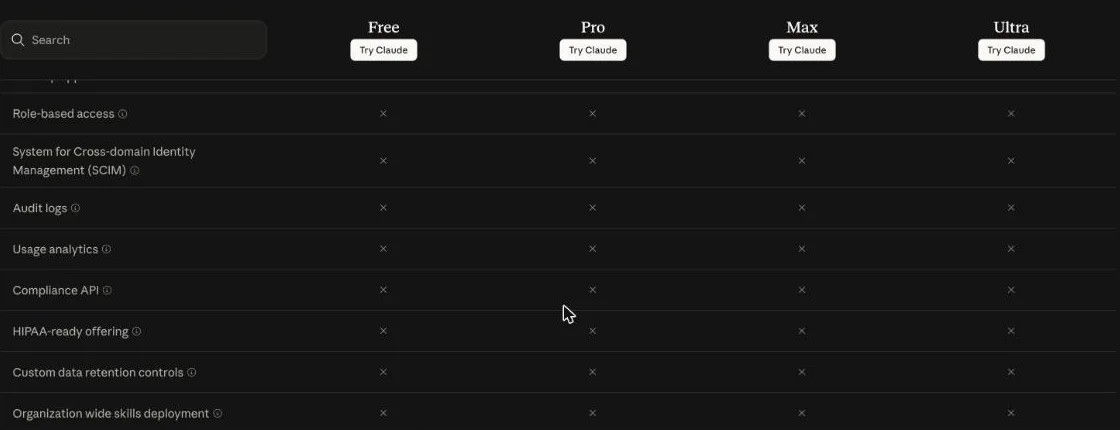
No. Team doesn't train on your data by default, but it can't enable HIPAA, and Claude's pricing page lists the HIPAA-ready offering as not included.
Is Claude Code HIPAA compliant?
Only in certain setups: on a HIPAA-ready Enterprise plan with the HIPAA configuration applied, or with zero data retention on qualified accounts. Cloud sessions and the VS Code and JetBrains extensions aren't covered.
Can I use Claude with my own health records?
Yes. In the US, Pro and Max subscribers can choose to connect lab results and health records. HIPAA rules apply to providers, plans and their vendors, not to you using your own data, so it's your choice. Read Anthropic's privacy terms first, and see is Claude safe.
Does a BAA make my practice HIPAA compliant?
No. It's required before a vendor handles patient data, but you still need your own risk analysis, access controls and staff rules.
Sources, checked 3 November 2026: Anthropic HIPAA-ready Enterprise plans, business associate agreements, covered models under a BAA, API and data retention, Claude pricing and Claude in healthcare; US Department of Health and Human Services guidance on HIPAA and cloud computing and de-identification guidance; AWS HIPAA eligible services. Plans and coverage change, so confirm against your signed agreement. This isn't legal advice.