 Citenook1
Blog · Guides
ChatGPT for doctors: what it's good for, what the studies show, and the rules
Doctors can use ChatGPT for drafts, patient handouts, letters and summaries of papers they've read, as long as they check every line. The two risks are confident errors and patient privacy. In one trial, doctors using GPT-4 diagnosed no better than doctors without it. In another study, AI drafts of patient replies risked severe harm in 7.1% of responses. For patient data in the US, use the free ChatGPT for Clinicians with its BAA signed, never a regular account.
This guide covers how doctors use AI in 2026, what the studies show task by task, which version of ChatGPT to use, the rules beyond HIPAA, specialist alternatives, a checklist and prompts that need no patient data. Facts come from peer-reviewed studies, the AMA, the Federation of State Medical Boards, state laws and OpenAI's own pages, checked on 18 November 2026. It's a summary, not medical or legal advice.
How doctors use AI in 2026
The AMA surveyed 1,692 physicians in January and February 2026. 72% used AI for at least one work task, up from 48% in 2024 and 38% in 2023. The survey counts AI tools in general, not ChatGPT alone, so "72% of doctors use ChatGPT" would be wrong.
| Task | 2026 | 2024 |
|---|---|---|
| Summaries of research and standards of care | 39% | 13% |
| Discharge instructions, care plans, progress notes | 30% | 20% |
| Billing codes, charts, visit notes | 28% | 21% |
| Chart summaries | 28% | 12% |
| Draft replies to patient portal messages | 19% | 9% |
| Help with diagnosis | 17% | 12% |
Two other numbers stand out. Patient privacy was the only area where more doctors expected AI to harm than help, and 71% worried about privacy with AI tools their employer didn't provide, against 42% for tools it did. 27% had no AI training at all.
What ChatGPT is good at in a practice
- Patient handouts and plain-language explanations. A condition, a procedure or after-care steps at a reading level you choose. In a 2023 study, reviewers preferred ChatGPT's answers to doctors' answers to public health questions 78.6% of the time, mostly for empathy. The answers were also four times longer, and the questions came from Reddit, not a clinic.
- Letters with no identifiers. Referral templates, prior authorization and appeal letter drafts. Add the patient details yourself in your EHR.
- Summaries of a paper or guideline you have open. A fast first read, before you check the methods and results yourself.
- Learning and board prep. Quiz questions and explanations of a mechanism. Exam scores don't equal real-world accuracy, as the studies below show.
- Admin writing. Clinic policies, staff emails, job ads, and coding questions you then check against payer rules.
Expect help, not a big time saving. In a Stanford pilot, 162 clinicians used AI-drafted replies to patient messages 20% of the time. Reply time didn't change, but reported work exhaustion went down.
What the studies show, task by task
| Task | Study | Finding |
|---|---|---|
| Diagnosis | Goh et al., JAMA Network Open, 2024. 50 physicians, randomized | Doctors with GPT-4 scored 76%, doctors without it 74%: no real difference. GPT-4 alone scored 16 points higher than the doctors without it. |
| Treatment decisions | Goh et al., Nature Medicine, 2025. 92 physicians, randomized | Doctors with GPT-4 scored 6.5% higher, and took about 2 minutes longer per case. |
| Replies to patient messages | Chen et al., Lancet Digital Health, 2024. GPT-4 drafts, 6 radiation oncologists | Drafts risked severe harm in 7.1% of responses and death in one (0.6%), mostly by getting the urgency wrong. They improved efficiency in 76.9%. |
| Cases with a wrong detail | Omar et al., Communications Medicine, 2025. 300 cases, 6 models | When a case contained one made-up detail, models built on it 50% to 82% of the time. |
| Drug questions | van Nuland et al., 2024. 30 hospital pharmacy questions | 26% of answers were correct and complete, 22% completely wrong, and only 10% stayed the same when regenerated. |
| References | Bhattacharyya et al., Cureus, 2023. Walters and Wilder, Scientific Reports, 2023 | 47% of GPT-3.5's references were made up. GPT-4 did better, but 18% were still made up. |
| Ambient scribes | Lukac et al., NEJM AI, 2025. 238 physicians, randomized | One scribe cut time in notes by 9.5%. The other made no significant difference. Clinically significant errors showed up occasionally. |
The pattern: the model alone often scores well on test cases, but a doctor using it doesn't reliably do better, and its mistakes sound as sure as its right answers. A 2026 Nature Medicine study of 1,298 members of the public found the same gap. Tested alone, the models named the right condition 94.9% of the time. People using them did so in under 34.5% of cases, no better than people without AI.
OpenAI's own test, HealthBench Professional (April 2026), scored ChatGPT for Clinicians at 59.0 against 43.7 for physician-written answers. OpenAI built it, picked its hard cases, and graded it with an AI, and the score isn't a percent correct. Read it as a sign of progress, not proof.
Which ChatGPT a doctor should use
| Version | Who it's for | Price | BAA for patient data |
|---|---|---|---|
| Free, Go, Plus, Pro | Anyone | Free to $500 a month | No |
| Business | Teams of 2 or more | $25 per user a month, $20 billed yearly | No |
| ChatGPT for Clinicians | Verified US clinicians with an NPI | Free | Yes, you sign it in Settings > Agreements |
| ChatGPT for Healthcare | Hospitals and health systems | Enterprise pricing, through sales | Yes |
ChatGPT for Clinicians launched on 22 April 2026. OpenAI's help page lists physicians (MD/DO), nurse practitioners, physician assistants and pharmacists. Its plans page also names psychologists and "other licensed clinicians", so verification decides. It can draft notes, referrals, prior authorization letters and patient instructions, search public sources such as PubMed and DailyMed, and earn CME credits. A newer Photon plugin drafts prescriptions for you to review and send. Controlled substances aren't supported.
Three rules from OpenAI's page: no patient data until the BAA is signed, none in third-party GPTs or connected apps, and no patient names or record numbers in searches of public sources. Plus, Business and the consumer Health feature have no BAA. Our guide to whether ChatGPT is HIPAA compliant covers which features the BAA leaves out, the API, and Copilot and Gemini.
The rules beyond HIPAA
- Your medical board. The Federation of State Medical Boards (April 2024) says boards regulate physicians, not tools, and "the physician is ultimately responsible for the use of AI." It also asks doctors to tell patients when and how AI is used in their care.
- Malpractice. The AMA (November 2024) says there's no clear legal standard yet, so the usual standard of care applies, and picking a tool with no evidence behind it could itself expose you to a claim. On 10 November 2026 the AMA said it will push for liability to rest with vendors when a defective AI product causes harm. That's a goal, not law.
- California, AB 3030. Practices that use generative AI to write patient messages about clinical information must add a disclaimer and say how to reach a human. The rule doesn't apply if a licensed provider read and reviewed the message.
- Texas, SB 1188 and TRAIGA. Since 1 September 2025, a practitioner using AI for diagnosis must review every record it creates and tell patients. Since 1 January 2026, TRAIGA also requires telling patients when AI is used in their care, by the time care starts, except in emergencies.
- Illinois, HB 1806. Since August 2025, AI can't make therapy or mental health treatment decisions, with fines up to $10,000. Admin and support tasks are allowed.
- The FDA. General chatbots aren't sold as cleared medical devices. The FDA's January 2026 guidance on decision support software turns on whether the doctor can check the basis of a recommendation rather than rely on it.
- OpenAI's own terms. Don't treat its output as a substitute for professional advice. Its usage policies ban automating high-stakes medical actions without human review.
In practice: review every AI message before a patient sees it, write down your own reasoning, and tell patients when AI played a part. Check your own state's rules too.
Specialist tools doctors use instead
| Tool | What it's for | Price, as listed | Patient data |
|---|---|---|---|
| OpenEvidence | Answers from medical literature, with sources | Free for verified US professionals | Says PHI from covered entities falls under its BAA |
| Doximity Ask | Clinical answers with evidence | Free for verified US clinicians | Calls itself HIPAA compliant |
| UpToDate Expert AI | Answers drawn only from UpToDate content | Included with UpToDate, from $579 a year | No HIPAA claim on the pages we read |
| Freed | AI scribe for visit notes | From $39 a month | BAA for groups |
| Heidi Health | AI scribe for visit notes | Free plan; paid prices not shown | BAA for covered entities |
| Dragon Copilot, Abridge | Scribes built into hospital EHRs | Not public | Sold to health systems |
"Specialist" doesn't automatically mean more accurate. A 2026 Nature Medicine study found GPT-5.2, Gemini 3.1 Pro and Claude Opus 4.6 beat OpenEvidence and UpToDate Expert AI on its tests. The real reasons to pick a specialist tool are curated sources, citations to real papers, a BAA and the price.
A checklist for your practice
- Pick one approved tool with a signed BAA for anything touching patients, and say which accounts are off-limits.
- Keep identifiers out of every other tool: names, dates of birth, record numbers, addresses, rare details that point to one person.
- Check drug doses and interactions in a drug reference, never in a chat answer.
- Open every reference before you rely on it or pass it on.
- Read every AI message before a patient gets it, and keep a human contact in it.
- Write down your reasoning when you follow or reject an AI suggestion.
- Tell patients when AI is part of their care, and follow your state's disclosure rules.
Prompts that need no patient data
- "Write a one-page handout on starting a statin, at a 6th-grade reading level, with three questions to ask at the next visit."
- "Draft a prior authorization appeal letter template for an MRI of the lumbar spine, with blanks for patient details and clinical findings."
- "Summarize the methods and main limitations of this paper in five bullets: [pasted abstract]."
- "Give me ten board-style questions on the workup of new atrial fibrillation, with explanations."
- "Rewrite this after-visit instruction so it's half as long and easier to read: [your text, no names]."
- "Draft a short clinic policy on when staff may use AI tools and what they must never paste."
When the answer is in your clinic's own files
Many questions in a clinic aren't about medical knowledge: what does our hypertension protocol say about referral, which formulary drug does this payer cover, what did the discharge summary change. The answer sits in your own documents, which are the files you shouldn't paste into a regular chatbot.
Citenook is a Mac app that answers questions from folders of protocols, letters, policies and notes without uploading them. With a model running on the Mac, the files, questions and answers stay on the Mac, and it works with Wi-Fi off. Every answer links to the sentence it came from. We tried it on three made-up files from a made-up clinic: a hypertension protocol, a referral letter to cardiology and a hospital discharge summary.
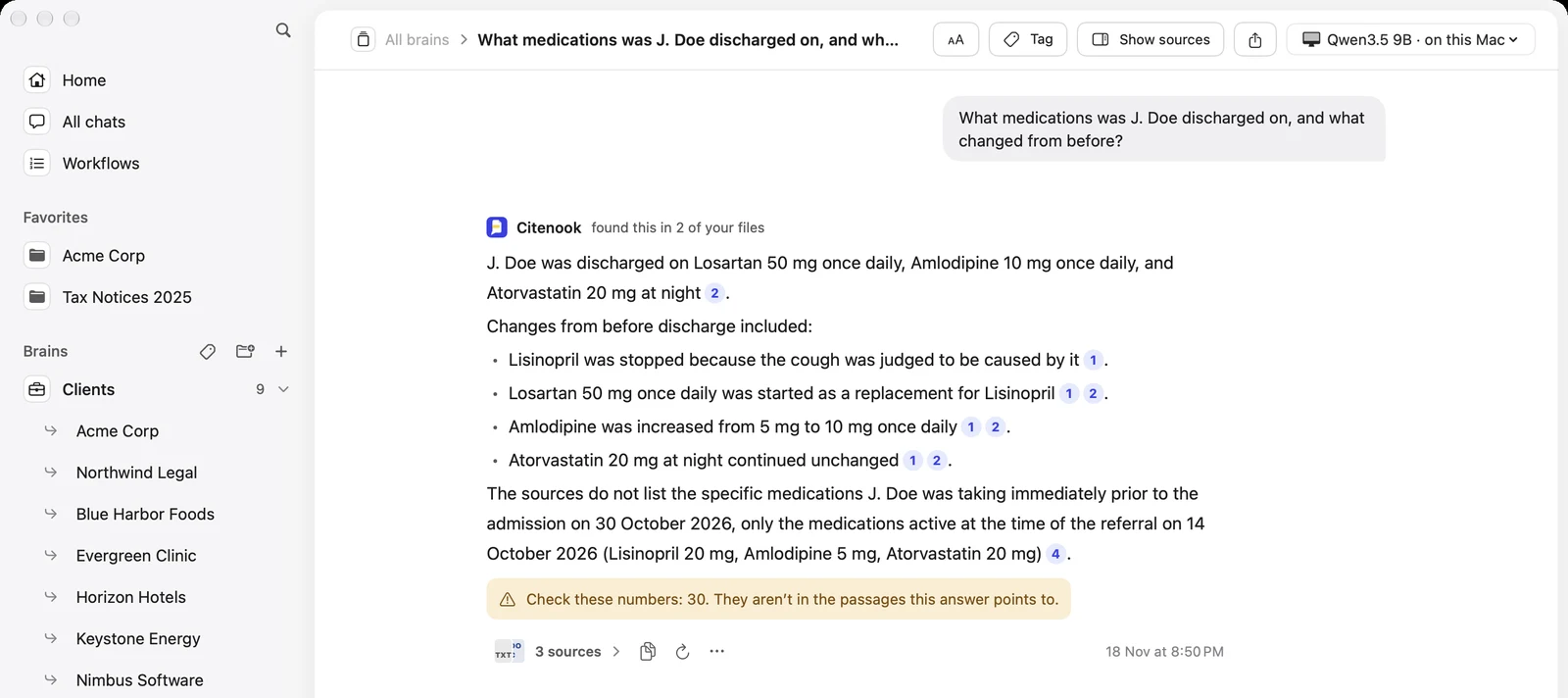
Asked when to refer a patient under the protocol, it gave the cardiology and nephrology rules, word for word from the protocol. Asked what J. Doe was discharged on and what changed, it listed the new medicines and the changes, and noted the referral letter's older list. It also flagged one number to check, the admission date, which wasn't in the passage it pointed to. It wasn't perfect: asked directly whether the referral letter and the discharge summary list the same medications, it said it couldn't find the answer, twice. Questions about one document at a time worked better.
Be clear about its limits: Citenook isn't a diagnostic tool, a drug reference, a scribe or an EHR plugin, and it gives no medical advice. It isn't certified for HIPAA and doesn't sign BAAs, and keeping files on a Mac doesn't replace your other duties, like disk encryption. It's for one person on a Mac with Apple silicon, free for 30 days, then from $9.99 a month. See how it fits doctors and exactly what goes where.
Questions
Can doctors use ChatGPT?
Yes, for tasks you check yourself: drafts, handouts, letters and summaries of papers you've read. Medical boards hold the doctor responsible for how AI is used, so review everything and keep patient data out unless a BAA covers it.
Is ChatGPT for Clinicians free?
Yes, for verified US clinicians with an NPI. OpenAI's help page lists physicians, nurse practitioners, physician assistants and pharmacists. It includes a BAA you sign in the app before using patient data.
Can I put patient information into ChatGPT?
Not into Free, Plus, Pro or Business: OpenAI offers no BAA for them. ChatGPT for Clinicians and ChatGPT for Healthcare come with one. Even then, keep patient data out of third-party GPTs and connected apps.
How accurate is ChatGPT for medical questions?
It scores well on exams and test cases, but trials show doctors using it don't reliably decide better, and it can repeat a wrong detail you give it. Drug answers and references are weak spots, so check them in a proper source.
Is OpenEvidence better than ChatGPT?
Not on raw accuracy: a 2026 Nature Medicine study found general models beat OpenEvidence and UpToDate Expert AI on its tests. OpenEvidence's strengths are answers grounded in medical journals, real citations, and being free for verified US professionals.
Do I have to tell patients I use AI?
In some states, yes. Texas requires it, and California requires a disclaimer on AI-written patient messages unless a provider reviewed them. The Federation of State Medical Boards recommends telling patients everywhere.
Sources, checked 18 November 2026: AMA 2026 Physician Survey on Augmented Intelligence, AI principles (November 2024) and its November 2026 AI policy release; FSMB AI policy (April 2024); studies: Goh et al. 2024 (doi:10.1001/jamanetworkopen.2024.40969), Goh et al. 2025 (doi:10.1038/s41591-024-03456-y), Chen et al. 2024 (doi:10.1016/S2589-7500(24)00060-8), Omar et al. 2025 (doi:10.1038/s43856-025-01021-3), van Nuland et al. 2024 (doi:10.1016/j.rcsop.2024.100464), Bhattacharyya et al. 2023 (doi:10.7759/cureus.39238), Walters and Wilder 2023 (doi:10.1038/s41598-023-41032-5), Lukac et al. 2025 (doi:10.1056/aioa2501000), Ayers et al. 2023 (doi:10.1001/jamainternmed.2023.1838), Garcia et al. 2024 (doi:10.1001/jamanetworkopen.2024.3201), Bean et al. 2026 (doi:10.1038/s41591-025-04074-y), Vishwanath et al. 2026 (doi:10.1038/s41591-026-04431-5); OpenAI ChatGPT for Clinicians, launch announcement, HIPAA eligible products, Business, HealthBench Professional paper, usage policies and terms of use; California Health and Safety Code 1339.75 (AB 3030); Texas SB 1188 and HB 149; Illinois IDFPR on HB 1806; FDA clinical decision support guidance (January 2026); vendor pages for OpenEvidence (archived copy, the site is unavailable in our region), Doximity, UpToDate, Freed and Heidi Health. Not medical or legal advice.